
Hypervigilance: When Your Body Is Always Looking for the Next Problem
By Briana Barela
June 7, 2026
Have you ever noticed that no matter how good things are going, part of you is still waiting for something to go wrong? Maybe you're constantly checking your phone. Maybe you replay conversations in your head trying to figure out what someone really meant. Maybe you finally have a quiet day, a peaceful relationship, or a moment where life feels stable, but instead of relaxing, you find yourself looking for the next problem. The next threat. The next disappointment. Or for the next shoe to drop.
If this sounds familiar, you may be experiencing hypervigilance. Hypervigilance is more than being observant. It’s more than being careful. It’s a state where your mind and body become so accustomed to searching for danger that they continue looking for it even when no immediate threat exists. And the exhausting part is that most people don't realize they're doing it. They assume they're simply being responsible, prepared, aware, and realistic. But there is a difference between awareness and constantly scanning your environment for something to be wrong.
One creates peace. The other creates exhaustion.
What Is Hypervigilance?
Hypervigilance is a heightened state of alertness where your nervous system continuously monitors people, situations, conversations, and environments for potential threats. Sometimes those threats are physical. More often, they are emotional.
You may find yourself constantly analyzing:
- People's moods
- Facial expressions
- Tone of voice
- Text messages
- Social interactions
- Future scenarios
Your brain becomes focused on prediction and prevention. If I can see the problem coming, maybe I can avoid getting hurt.
For many people, this pattern develops after years of chronic stress, emotional unpredictability, difficult relationships, trauma, or living in environments where they never felt fully safe. Over time, the body learns that staying alert feels safer than relaxing. The problem is that eventually your nervous system forgets how to turn off the alarm.
Hypervigilance is often proof that your body has spent too long preparing for danger.
Hypervigilance Symptoms
Hypervigilance can look different from person to person.
For some people, it feels like anxiety. For others, it feels like overthinking. For many highly sensitive people, it feels like intuition.
Some common hypervigilance symptoms include:
- Constant overthinking
- Difficulty relaxing
- Feeling "on edge"
- Easily startled
- Trouble sleeping
- Always expecting the worst-case scenario
- Reading deeply into conversations or text messages
- Feeling responsible for preventing problems
- Difficulty trusting people
- Feeling uncomfortable when life becomes calm
- Constantly monitoring other people's emotions
Many people spend years believing this is simply their personality. But more often than not, these are learned survival responses. And while those responses may have helped you navigate difficult periods of your life, they can become incredibly draining when they remain active long after the threat has passed.
The Link Between Hypervigilance and a Dysregulated Nervous System
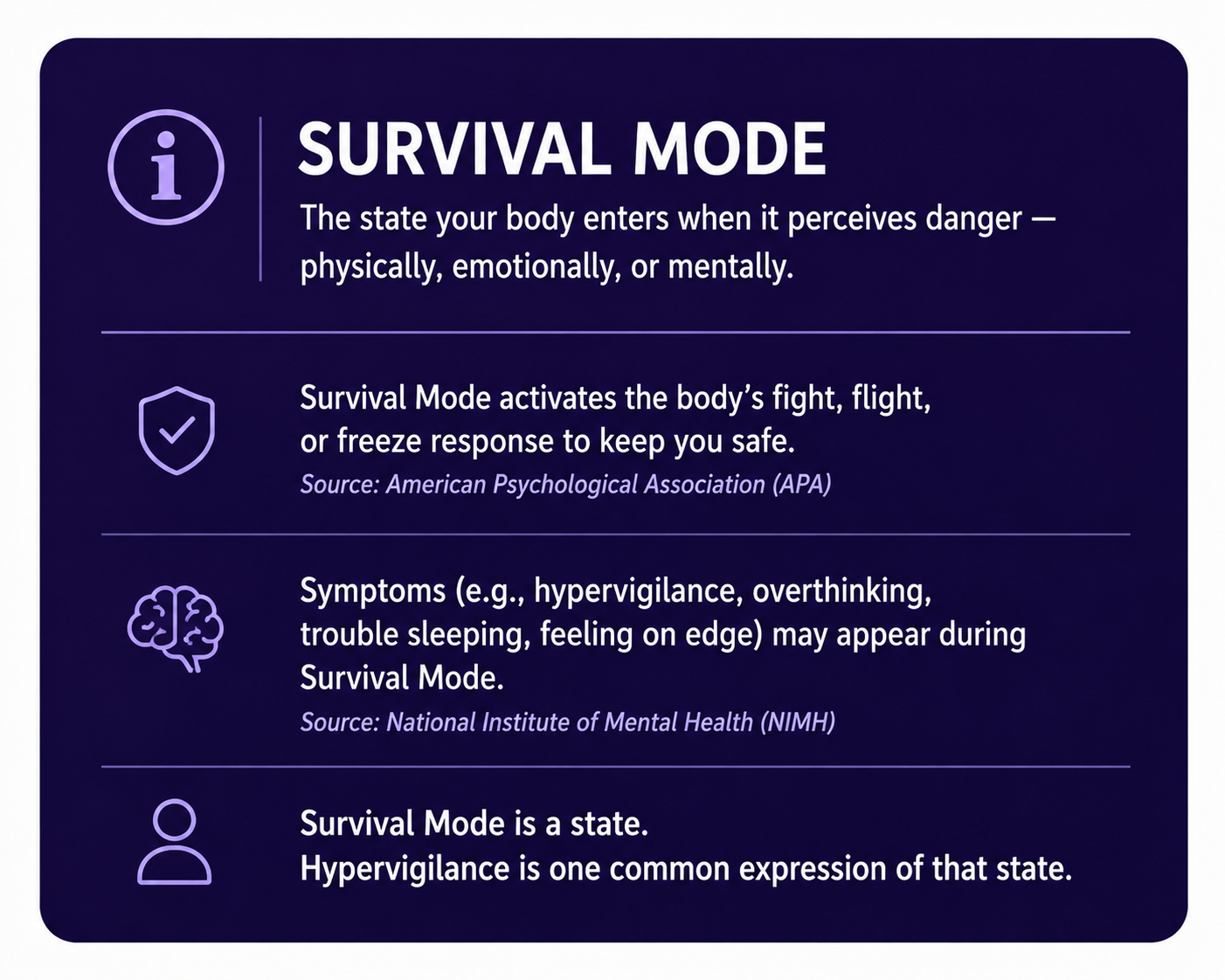 Hypervigilance and a dysregulated nervous system often go hand in hand. When your nervous system spends too much time in survival mode, it becomes increasingly difficult to distinguish between a genuine threat and a perceived threat.
Your body may react to someone not texting back right away. Or when someone seems distant you start to create scenarios in your head about what could possibly be wrong. The reaction often happens before your conscious mind has even had a chance to evaluate what is actually happening. This is why nervous system regulation has become such an important conversation.
Many people are trying to solve what appears to be a thinking problem when the issue is actually happening deeper within the body. A dysregulated nervous system keeps the body prepared for danger.
It prioritizes protection over presence and survival over peace. And when that happens, the mind naturally begins searching for evidence that validates the body's state of alertness - the body feels unsafe, so the mind starts looking for reasons why.
This is one reason why people can become trapped in cycles of anxiety, overthinking, people pleasing, perfectionism, and chronic stress. The nervous system is simply trying to protect them. The problem is that it often continues long after the emergency has ended.
If you haven't already, you may want to read Signs of a Dysregulated Nervous System (And Why You Feel Emotionally Overloaded).
Why Hypervigilance Can Make You Feel Emotionally Exhausted
Most people think exhaustion comes from doing too much. But sometimes it comes from constantly preparing for things that never happen. Hypervigilance requires a lot of energy. Your brain is constantly analyzing, monitoring, predicting, scanning, preparing, and preventing.
Even when you're sitting on the couch watching TV or lying in bed trying to sleep, your nervous system may still be standing guard. This is why so many people feel tired all the time even when they haven't done anything physically demanding. Their body is technically resting, but their nervous system isn't.
It's exhausting to spend your entire day waiting for the next problem. The next conflict. The next disappointment. Or the next emergency. And after a while, your body begins treating life like one long emergency.
Many people who identify as empaths and highly sensitive people eventually realize that what they have been calling intuition, sensitivity, or emotional overwhelm may also be connected to a nervous system that has spent years scanning for potential problems. This often becomes the turning point described in When an Empath Has Had Enough, when someone begins questioning whether constant vigilance is truly who they are or simply a survival pattern they learned to live with.
Why Hypervigilance Is Common in Highly Sensitive People
Many highly sensitive people didn't become hypervigilant because they were born that way. They became hypervigilant because at some point paying attention felt necessary.
Maybe you grew up around unpredictable people or someone's mood determined whether the day would be peaceful or chaotic. Maybe you learned to read the room before you learned to trust yourself.
So you started paying attention. You learned to notice subtle shifts in people's behavior. You learned to monitor emotions, body language, tone of voice, and energy. You learned how to anticipate problems before they happened because doing so felt safer than being caught off guard.
The problem is that eventually this pattern becomes automatic. You start monitoring everyone around you, including friends, family, coworkers, romantic partners, and even strangers. You begin searching for signs of rejection, conflict, disappointment, or danger before there is any evidence that those things actually exist.
Many highly sensitive people assume this is intuition. Sometimes it is. Sometimes it's simply a nervous system that has spent years practicing vigilance.
This could also be why certain relationships can feel so exhausting. You're not just participating in the relationship. You're constantly monitoring it. You're analyzing conversations, replaying interactions, wondering what someone meant, and trying to predict what might happen next.
If you've experienced this pattern, you may also relate to Why Being Around Certain People Exhausts You.
Ways to Regulate Your Nervous System
The good news is that hypervigilance is not permanent. The nervous system can learn safety just as it learned survival.
That doesn't happen overnight, and it doesn't happen by forcing yourself to relax. In fact, telling a hypervigilant person to "just relax" often creates frustration because the body doesn't feel safe enough to do so. Instead, nervous system regulation happens through small, consistent experiences of safety.
Some ways to regulate your nervous system include:
- Spending time in nature
- Deep breathing exercises
- Gentle movement such as yoga or somatic exercise
- Practicing mindfulness and presence
- Reducing overstimulation - social media, tv, excessive social gatherings
- Setting healthier emotional boundaries - with work, coworkers, family and friends
- Limiting exposure to unnecessary stress - other people’s problems are not your own
- Allowing yourself to rest without guilt
The goal is not to eliminate stress completely. The goal is to teach your body that not every situation requires a survival response.
If you're new to nervous system regulation, you may also want to read Your Nervous System Knows Before Your Mind Does, which explores how the body often recognizes stress and danger before the conscious mind catches up.
Signs Your Nervous System Is Learning Safety Again
One of the biggest misconceptions about healing is that you'll suddenly stop feeling stress or anxiety. Life will always have stressful times, but your reactions begin to soften.
You stop assuming the worst every time someone doesn't text back immediately. You stop replaying conversations for hours. You stop feeling responsible for preventing every possible problem. You stop searching for hidden meanings in every interaction. You begin trusting yourself more. You begin trusting other people more. You begin trusting life a little more.
Most importantly, you start realizing that not every uncomfortable feeling is a warning sign.
Sometimes it's uncertainty. Sometimes it's growth. And sometimes it's just a feeling passing through your body.
Hypervigilance is not awareness. It is the habit of searching for danger long after the danger has passed.
Final Thoughts
Hypervigilance is not proof that something bad is about to happen. More often, it is evidence that your body has spent too long preparing for danger.
The same nervous system that learned survival can also learn safety. With awareness, boundaries, nervous system regulation, and consistent practice, it is possible to stop living in a constant state of anticipation and start experiencing more presence, peace, and trust.
If you're ready to go deeper into nervous system regulation, energy work, and personal transformation, explore the resources and services available at Unleash Your Power. Your nervous system spent years learning how to protect you. It deserves the opportunity to learn what safety feels like, too.
Explore Other Articles
You're Not Lazy - Your Energy Is Overloaded
Are You Emotionally Dysregulated or Just Emotionally Overloaded?
How to Protect Your Energy Without Isolating Yourself
Disclaimer
This article is intended for educational and informational purposes only. It is not medical advice, mental health advice, diagnosis, or treatment. The concepts discussed throughout this article are meant to support self-awareness, personal growth, and understanding of the nervous system from both psychological and holistic perspectives.
If you are experiencing severe anxiety, depression, trauma-related symptoms, or any medical concerns, please seek support from a qualified healthcare professional. Always use your own discernment and make decisions that are appropriate for your unique circumstances.